“Statement Delivered at a
Press Conference in Front of Cheong Wa Dae”
The Korean Association of Retired
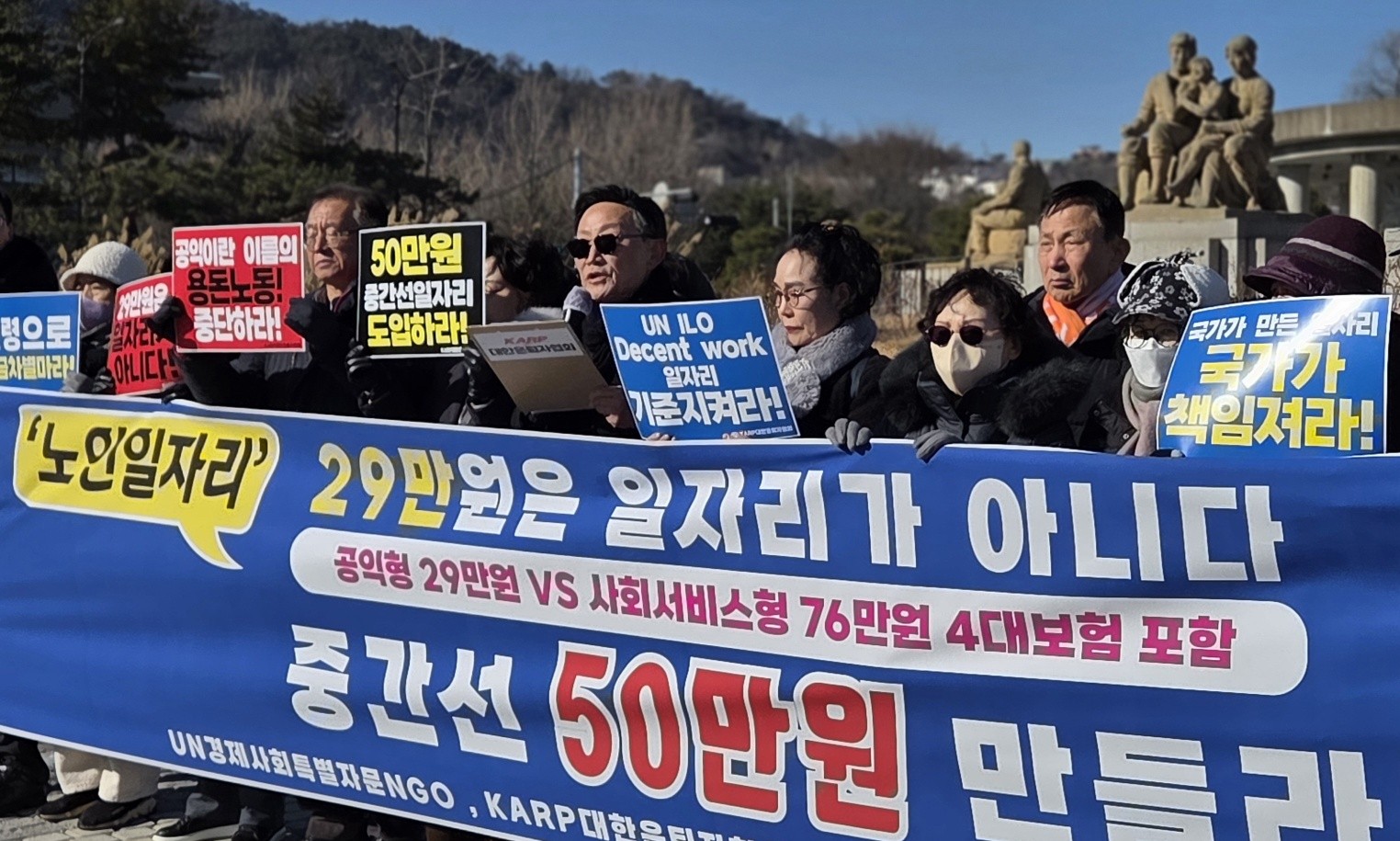
Persons (KARP, President Juch Myong-Yong) held a press conference at 2:00 p.m. on
January 20 in front of the Cheong Wa Dae Fountain Plaza, strongly urging the
government to introduce a “mid-level senior employment model” that would provide monthly compensation of 500,000
won, while
criticizing the unrealistic level of current public-interest senior job
stipends.
Despite a perceived
temperature of minus 20 degrees Celsius, about 20 KARP members gathered at the
site. In his statement, President Juch compared data from 2004, when the senior employment program was first
introduced, with current figures, pointing out a clear regression in policy.
According to the KARP’s
statement, when the public-interest senior job program was launched in 2004,
participants worked 30 hours per month and
received 200,000 won,
equivalent to 2.35 times the then-minimum wage (6,667 won per hour, based on a minimum
wage of 2,840 won).
However, 22 years later,
the stipend has increased by only 90,000 won,
reaching 290,000 won per month—a level
that represents not only a decline in real wages but also falls below today’s minimum wage
standard.
President Juch emphasized
that if the 2004 ratio (2.35 times the minimum wage) were applied to the current minimum wage,
monthly compensation should amount to 727,560 won.
Instead, participants receive only 290,000 won,
which he described as a clear and substantial real-term retreat, failing even to keep pace with inflation.
Applying an average annual inflation rate of
3%, the 200,000 won
paid in 2004 would be worth 384,000 won today.
Even based on the Bank of Korea’s
Consumer Price Index, the same
amount would equal approximately 328,000 won by the end of 2025.
President Juch also
criticized the severe wage disparity within government-run senior employment programs. Currently, there is a 2.62-fold gap between public-interest jobs (290,000 won) and skills-based or capacity-utilization jobs (approximately 760,000 won,
including social insurance).
He questioned why the
government, having implicitly acknowledged that 760,000 won is an appropriate compensation level for
senior labor, continues to pay a highly unrealistic 290,000 won to the majority of public-interest senior
job participants—especially when these participants are limited to basic pension recipients, who are generally in more financially
vulnerable situations than those eligible for skills-based positions.
As a realistic and
non-excessive alternative, KARP proposed a mid-level model providing 500,000 won per month for 35–40 hours of work, describing it as the most conservative and
administratively feasible solution to the contradictions between the existing
290,000-won and 760,000-won systems.
According to a Senior Employment Program Survey released on January 19 by the Korea Labor Force Development
Institute for the Aged,
respondents indicated a preference for working an average of 3.7 days per week, 3.6 hours per day,
and receiving approximately 598,000 won per month.
KARP also cautioned
against framing senior employment as a conflict with youth jobs, stressing that senior jobs do not compete with
youth employment,
but rather represent a last means of survival and a way to preserve dignity for older adults.
President Juch
underscored that KARP is a stakeholder organization that has participated in senior employment policy
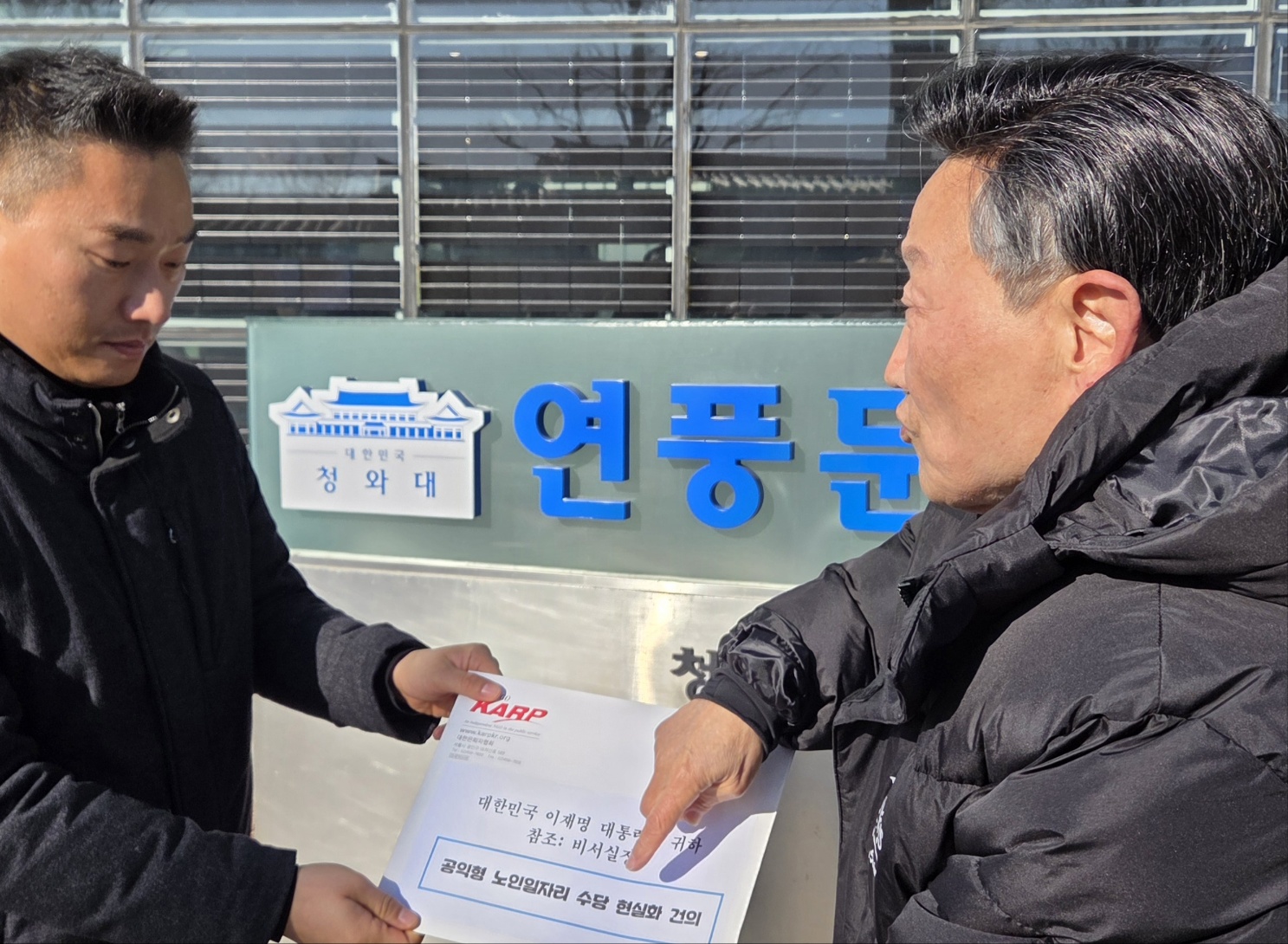
discussions since the Roh Moo-Hyun administration more than 20 years ago. After reading the statement, KARP formally
submitted a policy proposal to the Presidential Office, the National Assembly, and relevant ministries, demanding a clear and responsible response
from the President.
A KARP official stated,
“If this is to be called a ‘job,’ the state must calculate its value
honestly,”
urging the government to resolve this long-delayed national task through the upcoming budget process.